
A truck can be ready to leave while the information needed to move it is still scattered across three inboxes.
Picture an ordinary morning at a logistics company. A customer has changed an order without including its reference number. Sales needs a quote for a prospect whose volumes are buried in an email thread. Finance is preparing for a renewal. Dispatch has a truck nearby, but someone needs to check whether it is already promised to another customer.
Each request needs a decision. Before anyone can make it, someone has to reconstruct the facts.
That preparation is a useful place for AI agents to work. Given access to the right records and a defined procedure, an agent can investigate a request, bring the evidence together and prepare the next step. People can then spend more of their time reviewing an order, shaping an offer or choosing an assignment.
The five examples below follow that work across a logistics business. The first is a Witanalytica case study. The other four are proposed applications, with illustrative scenarios showing how they could work.
1. Turn customer emails into orders ready for review
Customer service and operations
For one third-party logistics provider, customer orders arrived in emails, PDFs, spreadsheets and scans. Customer service representatives read the documents and re-entered the details into Deposco, the warehouse management system.
We built a workflow that captures those requests, extracts the order details and checks customer identity, SKUs, quantities, units and duplicates before creating an order. Staff review the resulting order before fulfillment.
The agent layer addresses requests that need investigation, such as a quantity change referring to an earlier order. It can examine the conversation and system records to identify the intended order. Ambiguity goes to a person with the supporting evidence; changes pass through a validated write tool.
At the time of the published case study, extraction and insertion were live across three customers, with more than 100 orders entered automatically and no incorrect orders released to fulfillment in that reported experience. Human review remained in place. The agent layer was built and rolling out. Read the full order-entry case study.
The next opportunity begins earlier in the customer relationship, before there is an order to process.
2. Research prospects before Sales picks up the phone
Sales
A company name and a phone number give a salesperson somewhere to start. Preparing for a useful conversation takes more work: understanding what the company distributes, where it operates and what may have changed recently.
Imagine a manufacturer announcing an expansion into a region your logistics company serves. A salesperson could spend the next half hour moving between its website, location pages, news releases and CRM history. A research agent could assemble that background before the salesperson opens the record.
It would first establish which company it is researching, then examine its distribution footprint, manufacturing or inventory activity, existing facilities and relevant expansion plans. It could compare those findings with your service coverage and qualification criteria, preserving source links and dates along the way.
The output should be short enough to use before a call:
| Part of the brief | What Sales needs to see |
|---|---|
| Company and footprint | The correct business entity, locations and evidence of distribution activity |
| Reason to contact now | A dated expansion announcement or another relevant business event |
| Possible service fit | Where your warehousing or transport services could support that activity |
| What is still unknown | Whether the company outsources logistics, expected volumes and buying timeline |
| Opening question | A question grounded in the evidence, ready for the salesperson to adapt |
For the fictional manufacturer, that question might be: “How are you planning to handle storage and deliveries as the new regional operation comes online?”
The distinction between evidence and inference matters. An expansion announcement is evidence. A possible need for overflow warehousing is a hypothesis for Sales to explore. The brief should make both visible.
The company can also define which financial or legal checks are required before a lead progresses, using appropriate sources and review rules. Missing information stays visible. The immediate benefit to measure is research time and the usefulness of the handoff to Sales; conversion still depends on the offer, timing and customer conversation.
Once that conversation produces a serious enquiry, a different kind of preparation begins.
3. Bring the information for a quote together
Sales and operations
“Could you send us a price by Friday?” sounds straightforward. The request may include pallet volumes in a spreadsheet, handling requirements in meeting notes and a delivery promise in an email that Operations has not seen.
A quotation agent could turn those fragments into a service profile: expected volumes, storage needs, handling activities, transport requirements, service windows and special conditions. It would flag what is missing before anyone mistakes a provisional assumption for an agreed requirement.
That distinction changes the quality of the quote. Average inventory and peak inventory can imply different capacity requirements. A full-pallet movement and a mixed-case pick require different work. A narrow delivery window can change the transport options available.
With the requirements assembled, the agent could call approved calculation tools to estimate storage, handling, labor, transport and accessorial costs. Comparable customers could provide context, provided their differences in product, volume, service level and terms are accounted for. Operations would confirm the capacity needed to deliver the offer.
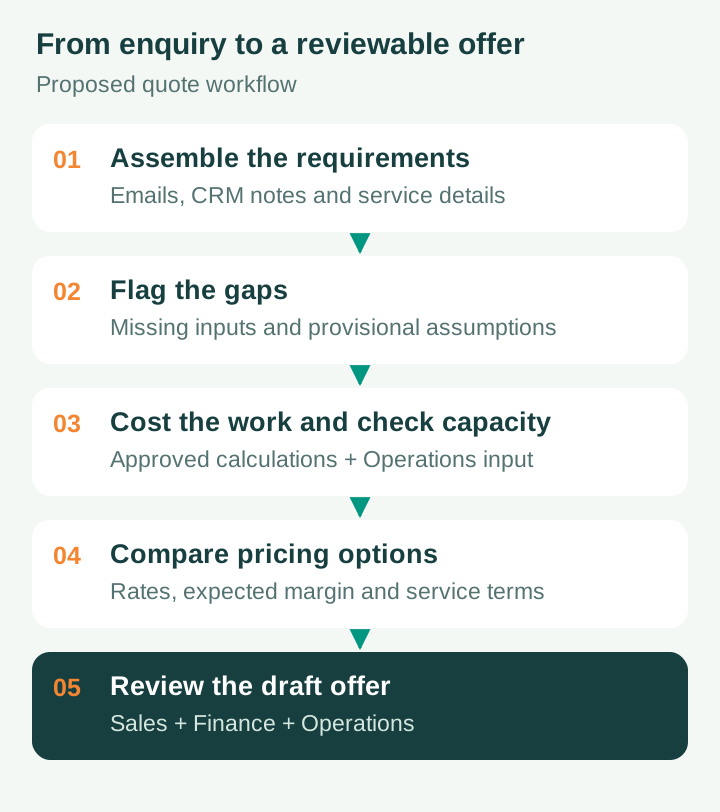
A proposed quote workflow. Missing inputs and unconfirmed capacity remain visible in the draft.
Sales would receive a quote pack containing the requirements, outstanding questions, cost breakdown, capacity status and pricing options. Every material number should point back to a rate, source record or stated assumption. Finance defines the margin method; Operations checks feasibility; Sales shapes the commercial offer.
Consider a customer asking for both standard and expedited delivery. The agent could prepare two scenarios using the same underlying requirements, explain the additional transport cost and show the effect on expected margin. If the expedited option still needs a capacity check, that qualification travels with the offer through review.
The team now has something concrete to discuss. A change in price can be traced to a change in service, cost or assumption. After the contract has been operating for a year, that same discipline becomes useful again.
4. Prepare for contract renewals using the customer's actual economics
Sales and finance
A customer can be growing and becoming less profitable at the same time.
More stock occupies the warehouse. Deliveries involve longer waits. Labor costs rise. Revenue still looks healthy, so the pressure on the account only becomes clear when someone joins the operating records to the invoices and costs.
A renewal agent could assemble that view before the customer conversation. It would bring together the contract, service activity, revenue, costs and payment history for a consistent customer and period, then identify what reconciles and what still needs investigation.
The fictional example below shows why this matters. Gross margin has fallen from 11.4% to 7.1%, a decline of 4.3 percentage points. The same example includes higher detention hours, storage volume and labor costs.
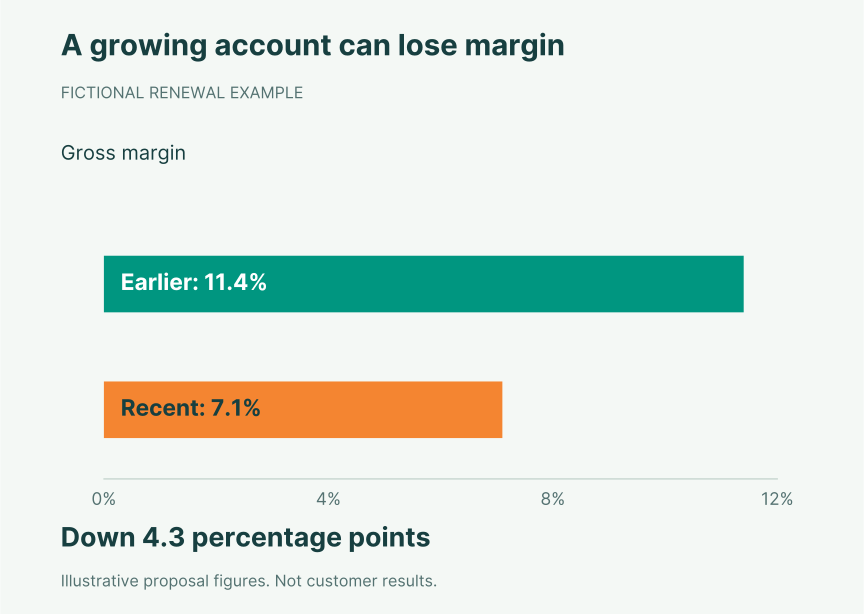
Illustrative figures from the proposal material, not measured customer results. The chart compares two margin values; it does not attribute the decline to individual causes.
The agent's job would be to investigate those causes and connect them to decisions the team can make:
| Signal in the fictional example | Question for the renewal review |
|---|---|
| Detention hours increased by 28% | Which waits were billable, which were charged and what did the remaining time cost? |
| Storage volume increased by 16% | Does the contract's storage tier still reflect the space being used? |
| Labor cost increased by 9% | Which handling activities absorbed the increase, and how are they priced? |
| Payments averaged 18 days late | Should Finance review payment terms and credit exposure? |
Those figures alone cannot establish the correct rate increase. The analysis needs to separate price, volume, service mix, cost changes and billing gaps. If some labor costs cannot be attributed reliably, the renewal pack should show that limitation.
Once the history is understood, the agent could prepare options: revise a handling rate, introduce a storage tier, adjust a minimum charge or change detention terms. Each scenario would show its assumptions and estimated effect. Historical actuals and next-period forecasts would remain separate.
Sales could enter the meeting with a clear explanation of how the account has changed and which terms deserve attention. Finance could inspect the calculations behind it.
Dispatch faces a similar need to bring facts together, often with only minutes to act.
5. Help dispatchers compare load assignments
Dispatch
The closest truck may already belong to someone else's plan.
A vehicle can appear available on a map while its driver is approaching the end of their available hours, its equipment is unsuitable, or its capacity is reserved under a customer agreement. A seemingly convenient pickup can disrupt a later delivery.
A dispatch agent could compare a new load against the information that determines whether an assignment is feasible: truck location, equipment, carrying capacity, driver eligibility and remaining hours, current assignments, delivery windows and customer restrictions.
It could then use routing and calculation tools to compare the supported choices, including a possible backhaul. The dispatcher would see the extra miles, time and estimated incremental cost of each option, together with the commitments affected.
Consider this illustrative comparison:
| Candidate | What the checks establish | What the dispatcher sees |
|---|---|---|
| A nearby truck dedicated to another customer | The agreement prohibits shared freight | Excluded, with the restriction identified |
| A truck returning along the corridor | Equipment, hours and delivery windows fit the proposed backhaul | A feasible option, with added miles, time and cost calculated |
| A shared vehicle finishing another delivery | Stop duration is unconfirmed and could affect the pickup window | Pending confirmation, with the missing information identified |
The dispatcher makes the assignment. If a truck's availability or a customer's timing changes, the options need to be recalculated.
This depends on an operational detail that is easy to overlook: commitments made by phone need to reach the shared records. An agent cannot protect a promise it cannot see. Establishing that visibility is part of building the solution.
Write the company knowledge once, then let people and agents use it
Across these five applications, the questions become specific very quickly. Which costs belong in margin? What makes a lead qualified? When can freight be combined? Which order changes need review?
Developing reliable solutions means writing those answers down as governed skills: reusable procedures with an owner, an approved version and a clear scope. A skill packages the required inputs, working steps, business rules, tools, exceptions and expected output. Supporting calculations and checks make the procedure testable.
For a renewal skill, that could mean specifying how to match a customer across systems, which contract period to use, how Finance calculates margin, how to flag unallocated costs and what the final renewal pack must contain. Representative examples should cover both routine cases and exceptions. Changes to the procedure should be reviewed, tested and recorded.
The same knowledge can then support two ways of working. An agent can prepare a renewal pack when a review date approaches. An account manager can use the approved skill in their company's permitted ChatGPT or Claude setup and ask for the same analysis during a meeting.
Employees can install or enable these capabilities through supported skills or plugins in ChatGPT, and upload or use shared custom skills in Claude. The distribution method depends on the product, subscription, workspace settings and required tools. OpenAI's guide to building skills and Anthropic's guide to using skills describe the supported approaches.
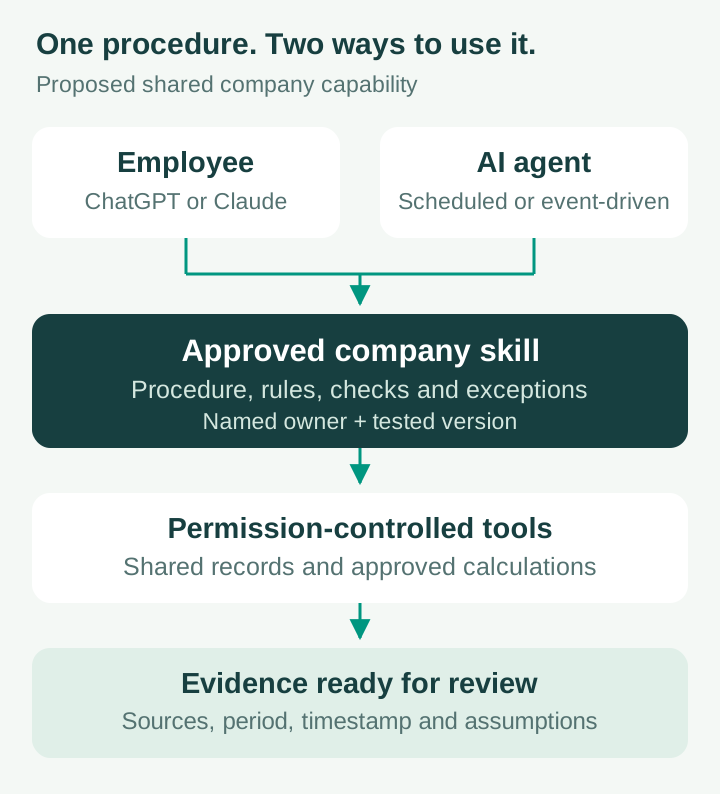
A proposed shared foundation: one maintained procedure, used interactively by employees and through automated workflows.
Consistency requires more than distributing a file. Both paths need the same approved business logic and authorized source data, with the customer, reporting period, data timestamp and skill version recorded. A shared tool connection, for example through the Model Context Protocol (MCP), can provide controlled access to those records and calculations. Access still follows each person's or agent's permissions.
The team should test both paths against the same examples. Wording may vary between AI systems; the underlying calculations, evidence and required checks should agree. When Finance updates a costing rule, the change belongs in the maintained procedure and calculation tool, with the approved version distributed to its users.
That gives people and agents a practical way to work side by side. An employee can inspect the numbers behind an agent's recommendation, question an assumption and rerun the analysis using the same procedure.
It also changes what happens when an experienced colleague leaves. The renewal method, customer exceptions and validation checks they helped document remain available to authorized coworkers. A new employee can reuse and learn from that knowledge. Keeping the skills current reduces dependence on memory and makes the company's way of working easier to preserve.
Return to that morning's unanswered requests. The order is ready for review. Sales has a reason to call and a quote it can explain. Finance can trace the renewal assumptions. Dispatch can compare feasible assignments.
The people making those decisions still need experience and judgment. Now, more of the preparation is already done, and the knowledge behind it belongs to the company.