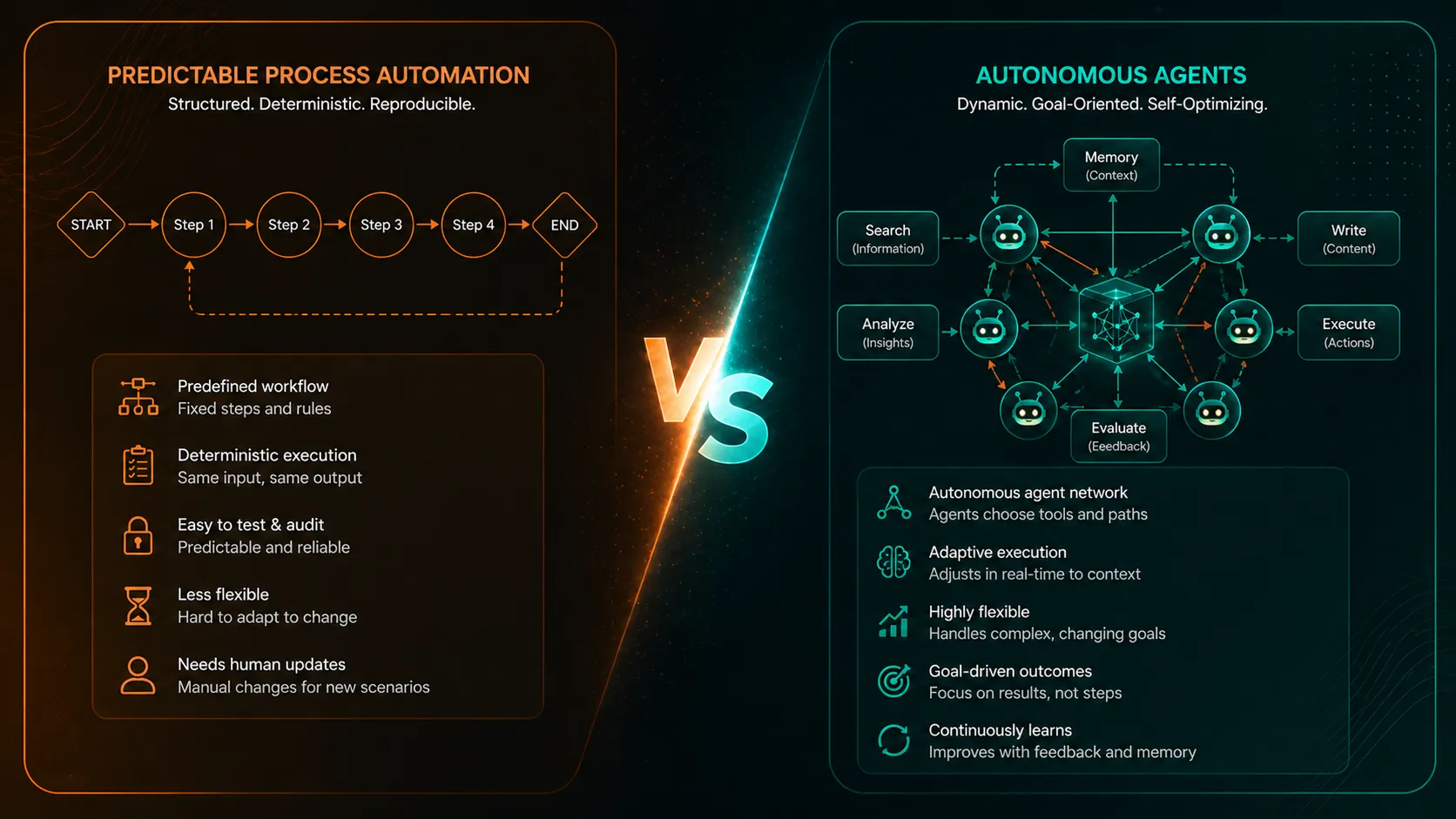
The most common AI agent question we get from CTOs, heads of data, and technical operators is some version of: "Should we use LangGraph or OpenClaw?"
It is a useful question, but it is not the first one. Some workflows should not use either tool. If the job is a deterministic ETL job, scheduled report, webhook handler, queue worker, or system-to-system update, normal engineering is usually the better answer.
LangGraph and OpenClaw become relevant after the work is genuinely agentic. LangGraph is a stateful orchestration framework for agent workflows where the steps, state, tool calls, retries, and approval gates should be explicit. OpenClaw is a self-hosted operator runtime for agents that need to inspect a bounded workspace and decide what to do next.
For a CIO or CTO, the real question is not "which framework is better?" It is: what problem are we solving?
Start with the operating decision
Before comparing features, separate three implementation shapes: deterministic automation, predictable agentic workflows, and autonomous operator work.
That sequence prevents the common mistake: using an agent framework where a normal job, integration, or workflow engine would be cheaper and more reliable.
If the task is a fixed report, notification, data pull, file movement, or system-to-system update, start with deterministic automation: an ETL or ELT job, scheduled script, webhook handler, queue worker, API integration, or workflow tool with retries and logging. Add LangGraph when the workflow needs model judgment inside explicit steps, durable state, branching, approval, or recovery. Evaluate OpenClaw when the value is that the agent can inspect a bounded environment, choose the next move, and operate with more autonomy. If neither description fits, the workflow is not ready for an agent framework yet.
What LangGraph is for
Choose LangGraph when AI should add judgment to a process the company can still explain, approve, recover, and audit.
The meeting argument is simple: LangGraph gives the organization the benefits of AI without turning the workflow into an opaque assistant session. It is for processes where leadership wants model reasoning, but still needs state, controls, and accountability.
LangGraph models an agent workflow as a state graph. You define the state object, nodes, transitions, tool calls, checkpoints, interrupts, and completion conditions. That makes it a strong fit when the workflow needs to behave like business software rather than an open-ended assistant session.
LangGraph is strongest when you need:
- Explicit state. You know what the workflow is tracking and what each step can change.
- Durable execution. Long-running processes can pause, resume, retry, and recover.
- Human approval gates. A workflow can stop, ask for approval, and continue from the same state.
- Governed tool use. Tools are intentionally exposed and can be scoped by tenant, user, or workflow.
- Clear debugging. You can inspect which node ran, which state changed, and why the workflow moved forward.
A typical LangGraph use case is conversational analytics over governed data. The agent receives a user question, loads tenant and conversation context, inspects schema documentation, runs guarded read-only SQL, checks precomputed findings, and returns an answer. The user experiences a helpful analyst. The company gets explicit state, tenant boundaries, query guardrails, memory controls, approval points, and step limits.
That is where LangGraph shines: not because it is more autonomous, but because it makes an AI-assisted process behave like production software.
What OpenClaw is for
Choose OpenClaw when the work is valuable because the agent can inspect a bounded environment, decide what matters next, and act as a visible operator for one team.
The meeting argument is also simple: OpenClaw is not the default agent framework for every employee. It is a controlled operator model for a department that benefits from autonomy, shared context, and scheduled attention.
OpenClaw is a different shape of product. It is a self-hosted gateway and operator runtime for autonomous sessions. It brings together sessions, tools, skills, plugins, scheduled triggers, hooks, task flows, and channel integrations such as Slack, Teams, Telegram, WhatsApp, or Discord.
The important distinction is that OpenClaw is not primarily a graph for a predefined business process. It is a runtime for an agent that receives a goal or trigger, inspects a bounded workspace, chooses actions, uses tools, and reports back through a human-facing surface.
OpenClaw is strongest when you need:
- Autonomous exploration. The agent needs to inspect a changing workspace and decide what to do next.
- Scheduled operator behavior. The agent wakes up on a trigger, reviews signals, decides which work matters, creates tasks, checks status, and reports back.
- Chat-native operations. A department interacts with the agent through a shared channel, not just an API.
- Broad but bounded tool access. The agent needs freedom inside a carefully prepared environment.
- A dedicated trust boundary. The runtime serves one team or one business scope, not hostile tenants.
The critical phrase is bounded environment. OpenClaw should not run on a laptop with access to a person's real files, browser sessions, SSH keys, and documents. Some teams discuss buying a dedicated Mac mini for this purpose. That is still better than a personal laptop, but it is usually an expensive and unnecessary answer. For company use, we prefer a fresh cloud VM with scoped files, scoped tools, clean credentials, logging, backups, and a human approval gate before production impact. For the full deployment argument, see OpenClaw for Companies.
One practical warning: do not assume every chat is private just because it happens in Slack, Discord, or a similar tool. In some OpenClaw setups, details from one conversation can bleed into another, especially when old context is summarized, the model is changed, or uploaded files from different chats share the same storage. That can expose private prompts, files, or admin context to the wrong person. In a bad case, a regular user could get the agent to act as if it were still inside an admin conversation. If you choose OpenClaw for chat, the safer pattern is a shared department channel: one team, one visible context, one clear authority boundary. Avoid private one-to-one chats for users with different permissions unless history, uploads, and credentials are isolated and tested.
The fundamental difference
Both tools can call models and tools. The difference is where control lives.
LangGraph is a better default when the agent workflow should be legible before it runs. OpenClaw is a better fit when the value is precisely that the agent decides the next step after looking at the current situation.
LangGraph vs OpenClaw across operating criteria
| Operating criterion | LangGraph | OpenClaw |
|---|---|---|
| Primary role | Stateful orchestration for explicit agent workflows | Self-hosted runtime for autonomous operator sessions |
| Best workflow shape | Agentic workflow with known steps, branching, approvals, and audit | Unknown path, exploratory work, operator-style autonomy |
| State model | Explicit graph state and checkpoints | Runtime sessions, transcripts, task flow, and workspace state |
| Scheduling | Usually external scheduler plus graph runtime | Native triggers, cron-style scheduling, hooks, heartbeat, and channels |
| Security posture | Application boundary, tenant-scoped state, explicit tools | Dedicated trust boundary, sandboxed runtime, scoped workspace |
| Multi-tenant fit | Better for customer-facing or department-isolated systems | Better for one team, one runtime, one business scope |
| Cost behavior | Easier to budget per node, model call, and tool call | Needs active controls for long sessions, persistent context, repeated tool context, and runtime drift |
| Operations fit | Standard backend engineering | Self-hosted runtime and platform operations |
| Practical default | Safer first choice for governed agent workflows | Strong choice only when bounded autonomy is required |
Cost, security, and staffing
For mid-market teams, the decisive criteria are rarely model intelligence in isolation. The real questions are operational.
Can we explain what happened on a bad day? LangGraph gives you clearer execution paths: node, state, tool call, approval, response. OpenClaw can keep transcripts and task logs, but you need to design the operational record more carefully because the agent is acting inside a broader runtime.
Can we keep the system inside our trust boundary? LangGraph fits more naturally into normal app boundaries, especially if you may later serve multiple customers, departments, or roles. OpenClaw can be safe for company use, but only when deployed as a dedicated runtime with scoped credentials and a constrained workspace.
Can finance predict the bill? LangGraph costs decompose into model calls, tool calls, hosting, persistence, and observability. OpenClaw can accumulate cost through persistent context, long-running sessions, heartbeats, and repeated tool context. It needs budgets, active hours, model-routing tiers, and per-task limits before rollout.
Can your team operate it? LangGraph feels closer to backend engineering. OpenClaw feels closer to running a dedicated automation appliance. Neither is zero-effort. The better choice is the one your team can observe, update, and debug without relying on one specialist to remember how it works.
How to choose
Ask the questions in this order.
- Can deterministic automation solve it? If an ETL job, scheduled script, webhook handler, queue worker, API integration, or workflow tool solves the job, do that first.
- Is the remaining work genuinely agentic? If the system does not need model judgment, tool use, state, or approval, do not add an agent framework.
- Can the agentic workflow be modeled explicitly? If yes, choose LangGraph for state, checkpoints, branching, retries, and approvals.
- Does the agent need to inspect a changing workspace and choose the next move? If yes, evaluate OpenClaw inside an isolated runtime.
- Do you need customer-facing or multi-department isolation? If yes, LangGraph or a normal application boundary is usually safer. Use OpenClaw only inside a dedicated trust boundary.
- Is there a deterministic backbone with exploratory pockets? Use normal automation or LangGraph for the spine, and an OpenClaw-style sandbox only for the bounded autonomous edge cases.
The selection logic, stated directly:
| Situation | Best answer |
|---|---|
| Fixed report, data sync, file movement, or system update | Use deterministic automation first |
| Multiple agentic steps with explicit state, approvals, and audit | Choose LangGraph first |
| Conversational analytics over governed data | Choose LangGraph with query guardrails and scoped tools |
| Chat-native internal operator for one team | Evaluate OpenClaw with strict sandboxing and cost controls |
| Autonomous operator that decides the next task from changing signals | Evaluate OpenClaw in an isolated runtime |
| Deterministic backbone with exploratory pockets | Normal automation or LangGraph for the spine; OpenClaw only for bounded autonomous pockets |
Two practical examples
Example 1: document intake and field completion. A supplier emails a contract amendment, an invoice, or an onboarding document. The agent reads the email, opens the attachment, extracts the required fields, checks the document against policy, asks for approval when something is unclear, and writes the result into CRM, ERP, or a workflow queue. The company cares about state, validation, approval, traceability, and recovery. That is a LangGraph-shaped problem.
Example 2: autonomous content operator. A healthcare provider wants an agent to review Search Console data, GA4 behavior, appointment availability, recent content, and indexing status every morning. There is no fixed output. Some days the right move is updating a high-impression page. Other days it is spotlighting a service line with open capacity. Other days it is drafting a guide for a rising symptom or procedure. The agent decides the next content move from the data. That is an OpenClaw-shaped problem, provided it runs in an isolated VM and a human reviews before production merge.
Our personal take
Use LangGraph when the work is complex but not very creative. The agent may need to read an email, inspect an attachment, understand a contract clause, extract the right fields, check a policy, and update a CRM or ERP record. The judgment matters, but the path should still be modeled, tested, approved, and audited.
Use OpenClaw when the value comes from more creative or strategic judgment. That might mean reviewing performance data, deciding which existing article should be improved, rewriting a section, drafting a new blog post, proposing an editorial calendar, or finding the next content opportunity. The agent is not just filling fields. It is choosing the next move.
Roll out in phases
Framework choice matters less than rollout discipline. The pattern that survives contact with reality is simple.
- Shadow mode. The system observes, recommends, and logs. It does not publish or write to production.
- Approval mode. The system drafts, proposes, or opens a branch. Humans review and approve.
- Limited autonomy. Only narrow, proven actions graduate to automation, with rate limits and rollback.
Track the same practical KPIs throughout: recommendation quality, approval rate, cycle time saved, cost per useful output, rollback rate, factual correction rate, indexing or completion time, and human review time saved.
The wrong question, reframed
"LangGraph or OpenClaw" is the wrong question because it assumes one tool needs to win.
The better question is: which workflows should be predictable, which should be autonomous, and which should not be agentic at all?
Predictable agent workflows translate into LangGraph nodes with state, retries, and approval gates. Genuinely open-ended operator work runs best as a sandboxed OpenClaw agent inside an isolated environment. Simple workflows get deterministic automation: ETL or ELT jobs, scheduled scripts, webhook handlers, queue workers, API integrations, and retry logic.
That is what we mean when we say architecture fit over framework fashion. If you want help applying that thinking to your workflows, our AI Agent Development practice is built around exactly this decision.
Frequently asked questions
Do I even need a framework, or will deterministic automation solve this? More often than most people admit, yes. An ETL or ELT job, scheduled script, webhook handler, queue worker, API client, and retry logic will cover a surprising number of automations. Even a single bounded model call can often sit inside a normal workflow without becoming an agent framework. Add a framework only when you hit persistence, branching, approval, or observability pain that normal automation cannot handle cleanly.
When do AI agents actually make sense for business automation? When the task requires judgment on unstructured or changing data, and the path through the workflow is not the same every time. If you can draw the process as a fixed flowchart and it does not need model reasoning, use deterministic automation. If the flowchart includes model reasoning, tool use, state, approvals, and audit, use LangGraph. If the agent must decide the path after inspecting the current situation, you are closer to OpenClaw territory.
Is OpenClaw secure enough for business use? Yes, with conditions. Treat it as a dedicated runtime inside one trust boundary. Use scoped credentials, scoped files, sandboxing, audit logging, separated chat history, separated uploads, and human approval before any production write. For chat access, prefer one shared department context over private conversations with different permission levels. For a full deployment breakdown, see OpenClaw for Companies.
How do I control token cost with OpenClaw? Set context-length limits, active hours, model-routing tiers, and per-task cost caps. Do not let a persistent runtime run continuously with full context injection. Monitor weekly.
Can I mix LangGraph and OpenClaw in the same system? Yes, but in exceptional cases. Normal automation or LangGraph can own the deterministic backbone: state, approvals, retries, and verification. OpenClaw can handle bounded autonomous pockets where the agent needs to explore and decide what to do next.
Self-hosted models or managed APIs? Start with managed APIs unless regulation, data locality, or unit economics clearly justify self-hosting. The operational burden of self-hosted models is real, especially for small IT teams.
MCP vs A2A: or both? Prioritize MCP first because it standardizes tool and data access. A2A is interesting when you have multiple independent agent systems that genuinely need to coordinate, but most mid-market teams are not there on day one.