AI Agent Development Services
Build AI agents only where they make business sense.
We turn repetitive analytics, reconciliation, content, and monitoring work into governed AI-assisted workflows. Some become LangGraph state machines, some become sandboxed OpenClaw operators, some become RAG knowledge assistants with cited answers, and some should stay simple scripts. The goal is production value, not framework fashion.
Book a Free Consultation
AI Agent Systems We Build
Conversational Analytics Agents
Ask business data questions in plain language and get answers backed by governed numbers. We build tenant-aware agents that inspect schema, run guarded read-only SQL or semantic-layer queries, and return charts, tables, and short narratives your team can trust.
AI Content Operations Agents
Scheduled agents that read Search Console, GA4, operational data, and CMS history, then decide the next content opportunity. They draft pages, prepare imagery, and push changes to a separate branch for human review before anything goes live.
Process Automation Agents
Predictable, multi-step automations for supply chain, retail, and operations workflows. Reconcile orders across ERP, WMS, and TMS. Match invoices to purchase orders. Route exceptions to the right humans. Built on LangGraph for state, retries, and audit-friendly execution.
Internal Copilots over BI and Operational Systems
Domain copilots for merchandisers, demand planners, fleet managers, and finance teams. They answer recurring questions, surface anomalies, and prepare draft actions in CRMs, ERPs, or BI tools while preserving tenant boundaries, tool scopes, and approval rules.
Document and Report Intelligence
Extract structured data from PDFs, scanned forms, proofs of delivery, lab reports, and contracts. Combine OCR, vision models, and reasoning agents to populate your databases and dashboards without manual re-keying.
Autonomous Research and Monitoring Agents
Agents that monitor competitor sites, marketplaces, regulations, or operational signals. They run on a schedule, summarize what changed, and escalate only when the decision is worth human attention, with cost, context, and runtime limits built in.
RAG Knowledge Assistants
Ask questions across policies, contracts, manuals, and past reports and get cited answers your team can verify. We build the full retrieval pipeline: structure-aware ingestion, hybrid keyword and vector search, reranking, and access controls enforced before any content reaches the model.
MCP Servers and Governed Tool Access
We expose your warehouse, ERP, CRM, and internal APIs to AI through Model Context Protocol servers that publish narrow, governed capabilities instead of raw credentials. One tool layer, reusable across Claude, ChatGPT, and your own agents, with scopes and audit logging built in.
How we design an AI agent system
First we decide whether the workflow should be agentic at all. Then we add data access, tool scopes, approvals, and cost controls before production.
Workflow fit
Script, LangGraph, or sandboxed operator
Data and tools
BI, warehouse, ERP, CRM, CMS, WMS, messaging
Guarded execution
State, scopes, budgets, logs, retries
Approval and action
Draft, branch, ticket, alert, write back
Each run produces evidence: what worked, what was approved, what failed, and what should be tuned next.
Representative Workflows
Healthcare network: AI content operations under human review
A multi-clinic healthcare network where we deployed a daily agent that reads Search Console queries, GA4 user behavior, and internal practitioner availability data. It produces a short summary, decides which new pages would best match patient demand, drafts the pages, generates hero imagery with GPT Image 2, and pushes everything to a separate branch. A human editor reviews and approves before publishing. Currently operating, results being measured.
Logistics and retail: process automation with deterministic steps
A reference architecture for 3PLs, distributors, and multi-warehouse retailers. A LangGraph workflow ingests order, shipment, and invoice data, reconciles exceptions against contracted rates and SLAs, routes anomalies to the right operations owner, and updates the data warehouse and BI dashboards. Steps are predefined, every transition is logged, and humans approve the high-impact actions.
Manufacturing: document intelligence at the line
A representative workflow where lab reports, quality forms, and supplier certificates flow through a vision-and-reasoning agent that extracts measurements, validates them against tolerances, and writes structured records into the manufacturing data warehouse for downstream BI and SPC analysis.
Technical whitepaper
A CIO guide to trusted analytics interfaces for AI agents
This companion whitepaper is written for CIOs, CTOs, and data leaders evaluating AI-agent workflows that touch revenue, billing, operations, manufacturing, and supply chain decisions. It explains why connecting an assistant to business applications is not enough, and how to expose governed analytics answers.
Designing MCP Servers for Business Analytics
A practical whitepaper for leaders designing agent-ready analytics interfaces, including concrete examples for:
- Retail & E-commerce Analytics
- Manufacturing Data Analytics
- Logistics & Supply Chain Analytics
PDF format, free to download.
When Do You Need AI Agent Development Services?
- You have recurring analytics, content, reconciliation, or monitoring work where the current process depends on manual review and copy-paste decisions.
- The workflow is too complex for a single prompt, but you are not sure whether it needs LangGraph, OpenClaw, normal code, or no agent framework at all.
- Your team needs AI to call real tools and data, but every action must be scoped, logged, and explainable when something goes wrong.
- You want agents to draft, recommend, or open branches in shadow mode before any production write, external send, or business-impacting action.
- You need cost controls, model routing, and approval rules before an agent is allowed to run every day.
- You tried generic AI chatbots and they hallucinate because they are not grounded in your governed data and operating context.
- Your policies, contracts, and past reports hold answers nobody can find, and off-the-shelf chat tools cannot cite sources or respect who is allowed to see which documents.
Why Choose Witanalytica for AI Agent Development?
We Are a Data Company First
Every Witanalytica AI agent is grounded in real, governed data: BigQuery, Snowflake, Power BI, GA4, Search Console, ERPs. We come from 18+ years of BI and data engineering, so we do not let agents hallucinate against your numbers.
Architecture Fit, Not Vendor Loyalty
We are not a Microsoft, Google, or Anthropic reseller. We pick the architecture based on the workflow, not the partner badge. Predictable processes get LangGraph. Broad autonomy gets a sandboxed runtime. Simple jobs get normal code, schedulers, and model calls. We track the wider framework landscape, from PydanticAI and CrewAI to the OpenAI Agents SDK, and recommend what fits.
Human-in-the-Loop by Default
Our agents do not silently push to production. They draft, propose, and queue actions for human approval where the cost of being wrong is non-trivial. You stay in control while still getting the speed.
Built for Audit and Cost Control
Every run is logged with inputs, model calls, tool calls, approval decisions, model costs, and outcomes. We design for cost predictability from day one: smaller models where possible, cached tool calls, and clear monitoring dashboards.
Production, Not Demoware
We have implemented agentic AI in pilots and production setups for analytics, content operations, and process automation, and we know the difference between a slick demo and an agent that runs reliably for months. Every system ships with an evaluation suite that gates changes before they reach production.
Aligned with Your Industries
Logistics, supply chain, retail, e-commerce, manufacturing, and healthcare. The same industries where we already build BI and data engineering practices.
Our AI Agent Delivery Process
We map the workflow you want to automate end to end. Inputs, decision points, exceptions, current owners, and what good looks like. We separate the parts that should be deterministic process automation from the parts where an autonomous agent adds real value.
We choose the right pattern: normal code for simple automation, LangGraph when steps are predictable and audit matters, and a sandboxed autonomous runtime when the agent must decide the next move. We design guardrails, data access policies, and approval checkpoints up front.
We connect the agent to your real data and systems: GA4, GSC, BigQuery, Snowflake, Power BI, ERP, CRM, ticketing, CMS, messaging. Read access first, with read-write surfaces introduced behind explicit approvals.
We run the agent on real data in a sandboxed environment, with all actions surfaced for human review before they reach production systems. We tune prompts, tools, and decision policies until quality and reliability meet your bar.
We build an evaluation dataset from real questions, edge cases, and observed failures, then score retrieval quality, answer groundedness, and tool correctness on every change. Prompts and models only ship when the eval suite passes.
We deploy on Google Cloud, your existing infrastructure, or a dedicated VM. Every run is logged with inputs, model calls, tool calls, costs, approvals, and outcomes. Dashboards make agent behavior as observable as any other production system.
We monitor success rates, latency, model spend, and human override frequency. We iterate on prompts, tools, and which model handles which step, swapping smaller models in where they perform well to keep costs predictable.
We map the workflow you want to automate end to end. Inputs, decision points, exceptions, current owners, and what good looks like. We separate the parts that should be deterministic process automation from the parts where an autonomous agent adds real value.
TESTIMONIALS
Witanalytica has been an awesome team to work with. They have such a talented team with a broad range of expertise in software development, BI and data analysis - which have all been instrumental in helping us achieve our technical goals. We truly value their partnership and look forward to continuing to work together.
Gregg Bansavage
CIO, RBW Logistics
Witanalytica has been an excellent partner in managing and optimizing our Tableau environment. Their team’s technical expertise and proactive support have streamlined our reporting processes, improved dashboard performance, and provided valuable insights to our business. Their responsiveness and deep understanding of data analytics make them a trusted extension of our own team.
Mark Lack
Director of Data Analytics and AI, The Ubique Group
Witanalytica helped us transition from Excel to a dynamic dashboard, allowing us to view all the relevant data and the KPIs that we track as a business. Instead of having our developers code an interface for weeks, we can now instantly accomplish this process through an interface, eliminating the need for manual coding.

Radu Albastroiu
Startup Founder, masinilacheie.ro
Witanalytica’s expertise in big data engineering and visualization complements our digital media audit and customer analytics services. Collaborating with them allows us to deliver end-to-end analytics solutions and services, without the risks and investments associated with building these capabilities in-house.

Silviu Toma
Senior Partner, Microanalytics
Working with Witanalytica has transformed our approach to reporting. Their expertise in PowerBI enabled us to go beyond the limited capabilities of Excel, allowing us to provide our clients with dynamic and visually captivating PowerBI dashboards. This capability has facilitated rapid testing, iteration, and the collection of customer feedback to improve our platform.

Alin Rosca
Startup Founder, RepsMate
Working with Witanalytica has been a consistently positive experience. They are responsive, professional, and approach every revision with patience and precision. What sets them apart is a strong understanding of supply chain management, inventory planning, and sales operations, which makes collaboration efficient and ensures deliverables align with real business needs. They have also worked effectively across multiple departments in our organization and manage a 6-7 hour time zone difference seamlessly. I would confidently recommend them to any organization seeking a skilled and dependable analytics partner.
Rubin Chen
Supply Chain VP, The Ubique Group
Frameworks, Models, and Systems We Use
LangChain
LangChain is our foundation for agents that need tool calling, retrieval, and validated write paths against your real business data. We use it where the agent has to reason over your systems and act inside clear boundaries, under human review.
LangGraph
LangGraph is the right framework when steps are predefined, state matters, and every transition needs to be auditable. We use it for process automation agents that run reliably in production.
OpenClaw
OpenClaw is useful when the work is open-ended and the agent must decide the next move. We deploy it in isolated VMs with scoped files, scoped credentials, audit logging, and human approval before production impact.
Anthropic Claude
Our go-to model for complex reasoning, long-context analysis, and tasks where instruction-following accuracy matters most. We use Claude across analytics agents, document intelligence, and agentic planning steps.
OpenAI
GPT for general reasoning and coding tasks, GPT Image 2 as our current default for generating high-quality hero imagery in content operations agents. We mix OpenAI and other providers per task based on quality, latency, and cost.
Retrieval and Vector Search
RAG pipelines on PostgreSQL with pgvector, BigQuery vector search, or a dedicated vector database when scale demands it. We combine keyword and vector retrieval with reranking, because retrieval quality decides whether a knowledge assistant gets trusted or ignored.
Observability, Evaluation, and Cost Control
Langfuse or LangSmith tracing on every run, with RAGAS and DeepEval-style evaluation suites acting as release gates. A gateway layer handles model routing, fallbacks, budgets, and per-agent spend attribution so cost stays visible and controlled.
Cloud and Deployment
We deploy production agents on Google Cloud (Compute Engine, Cloud Run), AWS, or Azure. Where data residency or compliance requires it, we run agents in dedicated isolated VMs inside your own infrastructure, including self-hosted open-weight models when data cannot leave your environment.
Our AI Agent Development Pricing Models
Transparent pricing built for long-term partnerships, not one-off transactions.
On-Demand Expertise
All tasks are tracked, and the corresponding invoice of the delivered services is billed monthly.
| Activity | Hourly Rate |
|---|---|
| AI Agents Development and Implementation | $100 |
| Data Engineering & Database Administration | $110 |
| Business Intelligence Reporting | $90 |
| Data Science | $120 |
Reserved Capacity Agreement
- Pre-purchase a package of monthly working hours that guarantees reserved capacity and priority availability, regardless of our workload.
- Because this capacity is exclusively allocated to you, unused hours do not carry over to the following month.
| Hours Package | Price |
|---|---|
| Every 50 hours | $4,500 10% savings |
Alternatively, we also offer project-based pricing
For well-defined engagements, we scope the full project upfront and agree on a fixed fee, so you know exactly what to expect.
Case Studies for AI Agent Development Services
Explore real life case studies and see how we delivered measurable outcomes in similar situations.
Showing 3 case studies

Airline Complaint Digitization: Handwritten Forms and Web Intake to Zendesk with OCR and GPT-4
How we built a 2023 proof of concept for a European flag carrier that turns handwritten airport complaint forms and structured web submissions into a single Zendesk ticket stream, using AWS Textract for OCR, GPT-4 as a semantic parser, and a mandatory human review step. Includes how we would build it today.
Read case study →
Measurement System Analysis: When the Gauge Is the Defect
A pharmaceutical manufacturer's pass rates looked healthy until the same measurement was stratified by the machine that took it. Coloring one scatter plot by checking station ID exposed a reproducibility failure that aggregate SPC had hidden, and a prescriptive agent layer turned each drift alert into a drafted corrective action.
Read case study →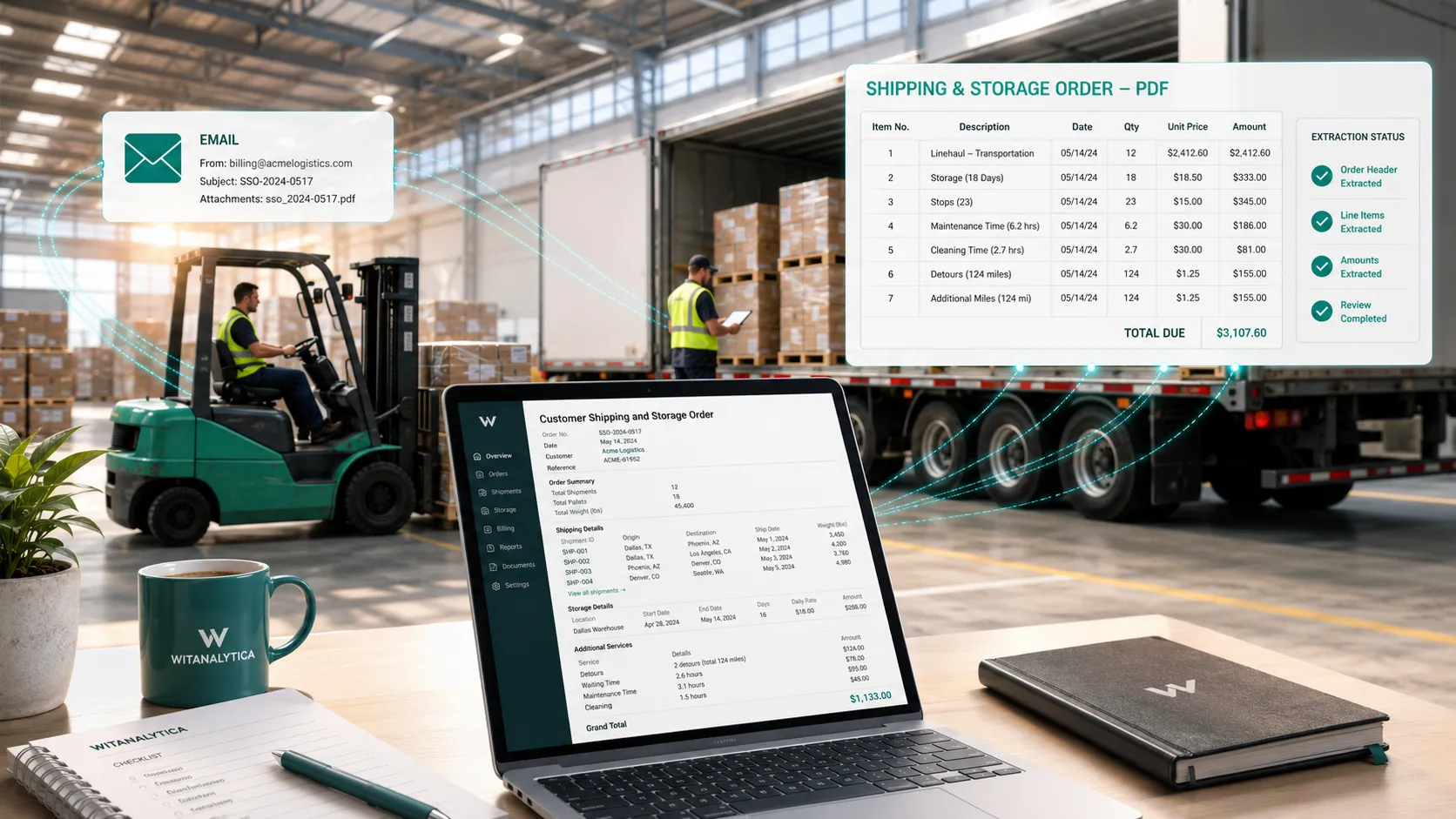
3PL Automated Order Entry: From Email to Deposco with AI Agents
How a 3PL provider eliminated manual order entry by using AI to read customer order emails and attachments, agents to investigate ambiguous requests, and validation rules to control what reaches the warehouse management system.
Read case study →Insights on Agentic AI
How we think about AI agents, frameworks, and production deployments.
7 articles

5 ways AI Agents can help logistics companies
From order entry to sales research, quotes, renewals and dispatch: five practical uses for AI agents, built around shared company knowledge and human decisions.

Why AI Agents Still Get Business Questions Wrong
MCP and APIs can connect Claude to business apps, but they do not guarantee trusted answers. Learn why AI agents still need governed business definitions.
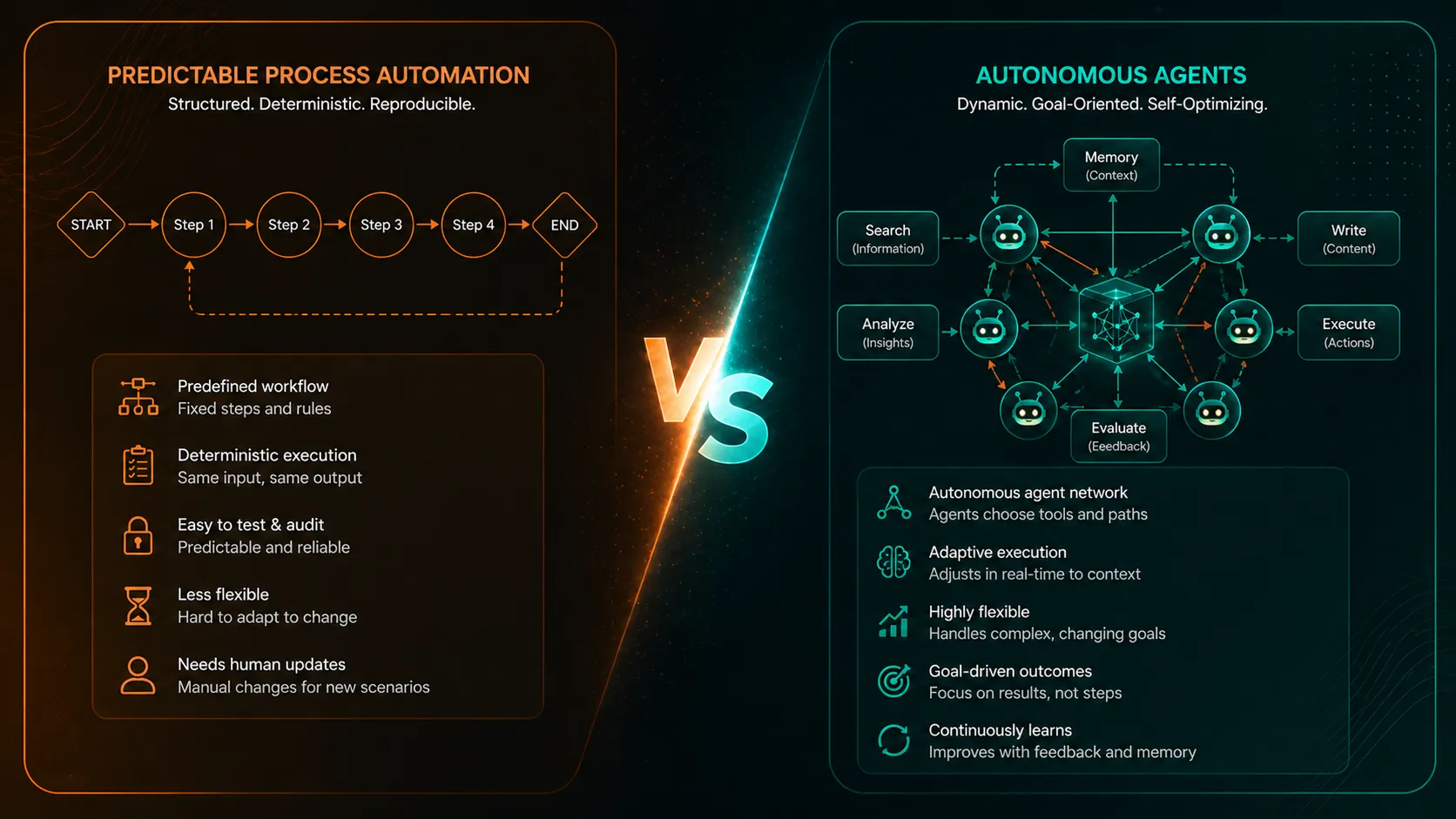
LangGraph vs OpenClaw: How to Choose Between Predictable Automation and Autonomous Agents
Read along to understand when LangGraph is safer, and when OpenClaw's autonomy is worth the risk.

OpenClaw for Companies: Why a Powerful AI Agent Does Not Belong on Your Laptop
OpenClaw is powerful precisely because it can read everything and change everything. That is exactly why it should not run on your laptop, your Mac Studio, or any device that holds your real files. Here is how we deploy it safely in disposable cloud VMs.
LLMs for Business Leaders: Applications Across Departments
LLMs go beyond chatbots. Learn how business leaders apply them to customer service, marketing automation, HR workflows, and internal knowledge management.

LLMs for Data Analytics: Extracting Business Insights with AI
LLMs do more than generate text. See how they integrate with analytics workflows to surface patterns, automate reporting, and speed up decision-making.

Generative AI Hyper-Personalization: Beyond Segmentation
Generative AI enables one-to-one personalization at scale. Explore how it challenges segment-based marketing and transforms targeting and customer experience.
Your Goals, Our Expertise
We start from your strategic objectives and work our way back to the right mix of solutions and technologies, not the other way round.
Book a Consulting CallAI Agent Development FAQs
A chatbot answers a single question with a single response. An AI agent reasons over multiple steps, calls tools, reads and writes data, and works toward an outcome that may take seconds or hours. An agent has memory, state, and the ability to act on systems, not just talk.
Agentic AI is the design pattern where AI systems take multi-step actions toward a goal using tools, data sources, memory, and workflow state. In business settings, the important question is not autonomy for its own sake. It is whether the system can act inside clear boundaries, with logging, approvals, and cost controls.
LangGraph fits process automation: when steps are predefined, every transition matters, and audit and reliability are critical. OpenClaw and similar autonomous agents fit open-ended work where the agent needs to choose the next move, inside a sandboxed environment. Many workflows should start simpler, with normal code, a scheduler, API calls, and a model only where it adds value.
Agents run inside your cloud or in an environment you control. Data access is scoped with service accounts, row-level security, and read-only by default. We never use a prompt as a security boundary: authorization is enforced deterministically at the tool and data layer, each agent gets its own workload identity and a kill switch, and we test against prompt injection and the OWASP GenAI risk list. For sensitive deployments we use isolated VMs, network policies, and human approval before any write. Our processes align with GDPR.
Yes. The agents we build are grounded on your existing semantic layer: Power BI datasets, Tableau data sources, dbt models, BigQuery views, or Snowflake schemas. The agent consumes the same governed metrics your team already trusts.
In our experience, no. They remove repetitive work and accelerate first drafts so your team focuses on judgement, customer-facing decisions, and edge cases. Our default design keeps a human in the loop for any action that has real business impact.
A focused agent for one workflow, grounded on existing data, typically goes from discovery to a supervised production pilot in 4 to 8 weeks. Broader agentic systems with multiple integrations and approval workflows take longer.
We are model-agnostic. We use Google Gemini models through the Gemini API, Anthropic Claude, and OpenAI models including GPT Image 2 for image generation. We pick per task, often mixing a high-capability model for reasoning with a smaller, cheaper model for routine steps. The model provider should support the architecture, not define it.
A simple rule settles most of it: facts belong in databases and retrieval, behavior belongs in prompts or model weights, and permissions belong outside both. Company knowledge that changes, needs citations, or has access rules should be served through RAG and governed tools, never trained into a model. Fine-tuning earns its place only for narrow, high-volume tasks, often by distilling a frontier model into a smaller, cheaper one after the workflow is proven. Most teams need better retrieval and tools, not a custom model.
We build an evaluation dataset before we optimize anything: straightforward questions, hard multi-document cases, questions that should be refused, and every failure found in testing or production. We score retrieval and generation separately, so we can tell whether a wrong answer came from missing evidence or from the model ignoring good evidence, and check tool calls against expected and forbidden actions. That suite runs on every prompt or model change and blocks the release if critical cases regress.
Model Context Protocol is the emerging standard for connecting AI to tools and data. Instead of wiring each assistant to each system, you build one MCP server that exposes narrow, governed capabilities, such as get_order_status or query_approved_metrics, rather than raw database credentials. Claude, ChatGPT, and your own agents can all use it, with authorization and audit enforced at the tool layer. We build MCP servers over warehouses, ERPs, CRMs, and internal APIs.
We set per-run and per-day budgets, cache tool calls and embeddings, and route routine steps to smaller models. We monitor token usage in dashboards alongside business outcomes so cost is always visible against value.
Yes. We often work alongside in-house teams: we design the architecture, the guardrails, and the evaluation framework, then either implement end to end or hand it off with documentation and training.
We offer two engagement models with transparent pricing.
On-Demand Expertise
All work is tracked and billed monthly at hourly rates:
- AI Agents Development and Implementation - $100/hr
- Data Engineering & Database Administration - $110/hr
- Business Intelligence Reporting - $90/hr
- Data Science - $120/hr
Reserved Capacity Agreement
- Pre-purchase a 50-hour monthly package at $4,500 (10% savings)
- Guaranteed priority availability regardless of our workload
We also offer project-based pricing for well-defined engagements.
Contact us to discuss the best fit for your needs.